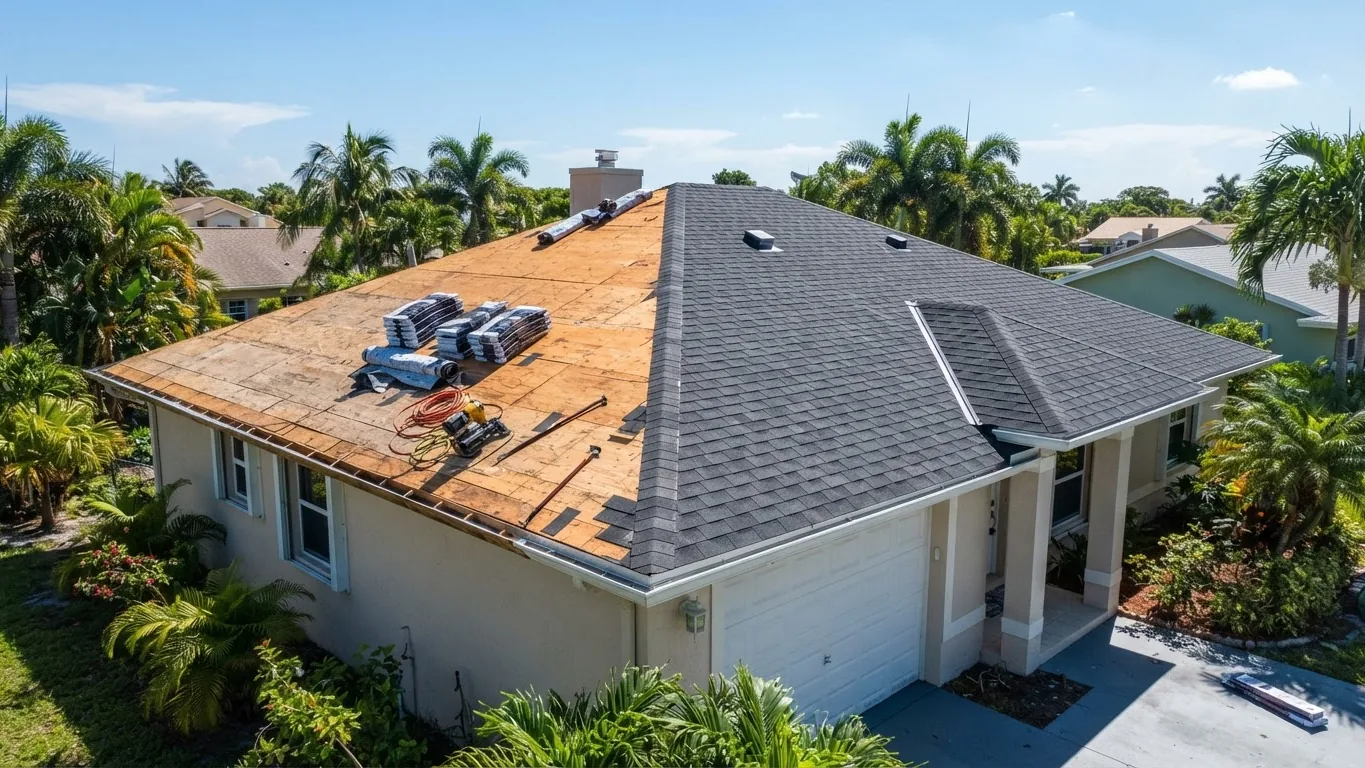
Few building rules cost Florida homeowners more money by surprise than the "25% rule." It can quietly turn a modest roof repair into a full replacement - or, thanks to a 2022 change, leave your roof alone entirely. Which one applies to your house depends on details most quotes never explain. Here is how the 25% rule works, the exemption that changed it, and why it hits harder in Broward and Miami-Dade.
What the 25% rule actually says
In its original form, the rule is simple and expensive: if more than 25% of a roof section is repaired, replaced or recovered within any 12-month period, that entire roof section has to be brought up to the current Florida Building Code - not just the part you touched. The idea, rooted in the code's wind-resistance provisions, is that once you are reworking a quarter of a roof, the whole thing should meet modern standards. On an older roof that can mean a small leak repair triggers a code-compliant replacement of the whole slope.
How the percentage is calculated
The percentage is not guessed - a building official measures it. The area being repaired or replaced is divided by the total roof-covering area, with all slopes and sections included in that total.
- It is based on roof area, not cost
- All slopes and sections count toward the total
- Separate repair projects within the same 12 months are added together - you cannot split a job to stay under 25%
- The building department, not the contractor, makes the final call
The SB 4-D exemption that changed everything (2022)
After the 2021 Surfside collapse, Florida passed Senate Bill 4-D, which took effect in May 2022 and softened the rule significantly. The key change: if your roof - or the specific section - was built, repaired or replaced in compliance with the 2007 Florida Building Code or any later edition, then only the repaired or replaced portion has to meet current code, no matter how much of the roof is involved.
In plain terms, most roofs installed or re-roofed after roughly March 1, 2009 (when the 2007 code took effect) are no longer subject to the old all-or-nothing requirement. That is a major cost difference for a lot of homeowners.
So does the rule still apply to your house?
It comes down to when your current roof was permitted:
- Roof permitted (built or last replaced) under the 2007 FBC or later - roughly March 2009 onward: the SB 4-D exemption generally applies, so you can repair or replace more than 25% of a section without redoing the rest
- Roof permitted before March 1, 2009: the original 25% rule still applies in full - cross 25% and the whole section must come up to current code
- Not sure when your roof was permitted: your city or county building department can tell you from the permit history
This is general information, not legal advice - confirm your specific situation with your local building department. Renomatix is not affiliated with, endorsed by, or acting on behalf of any government agency or program.
Why this matters more in Broward and Miami-Dade
When a full-section replacement is triggered, where you live decides how demanding "current code" is - and Broward and Miami-Dade are Florida's only two High-Velocity Hurricane Zone (HVHZ) counties. Bringing a roof section up to HVHZ code is a bigger job than elsewhere in the state:
- Every material must carry a current product approval - see our guide to what a Miami-Dade NOA is
- A secondary water barrier and re-nailed deck are required
- The work runs through the HVHZ permit and 3+ inspections
So a repair that crosses 25% on a pre-2009 Broward roof is not just a bigger repair - it is a full HVHZ-code replacement of that section. Knowing this before you start protects you from a nasty mid-project surprise.
The 12-month clock - repairs add up
One detail catches homeowners out: the 25% is measured across a rolling 12-month window, and separate jobs are combined. Patch 15% of a slope in the spring and another 15% in the fall, and you have crossed 25% for the year - which can trigger the full-section requirement on an older roof even though you never did one large repair. If your roof is near the line, it is often smarter to plan one properly permitted project than to nibble at it in pieces.
What's changing next
The Florida Building Code keeps evolving. The 9th Edition of the FBC is scheduled to take effect on December 31, 2026, and continues to refine how partial roof work is handled. Because the details can shift between editions - and because cities interpret them - the safest move is always to confirm the current requirement with your local building department or a licensed contractor before you commit to a repair or replacement. See our guide to what's confirmed so far in the 9th Edition for roofing and HVAC permits.
Frequently asked questions
What is the 25% roof rule in Florida?
If more than 25% of a roof section is repaired, replaced or recovered within 12 months, that section must be brought up to the current Florida Building Code. A 2022 law (SB 4-D) exempts roofs built or last replaced under the 2007 code or later, so only newer roofs escape the all-or-nothing version.
Does the 25% rule still apply after 2022?
Yes, but with a big exemption. For roofs permitted before March 1, 2009, the full rule still applies. For roofs built or re-roofed under the 2007 FBC or later, only the repaired portion must meet current code.
How is the 25% measured?
By roof area, not cost. A building official divides the area being repaired or replaced by the total roof-covering area across all slopes and sections. Multiple repairs within 12 months are added together.
Why does the rule cost more in Broward or Miami-Dade?
Because both counties are in the HVHZ, a triggered full-section replacement must meet High-Velocity Hurricane Zone code - NOA-approved materials, a secondary water barrier, deck re-nailing and multiple inspections - which is more involved than elsewhere in Florida.
Getting started
The 25% rule is exactly the kind of detail that separates an experienced South Florida roofer from a cheap quote - the right contractor checks your permit history and tells you up front whether a repair risks triggering a full replacement. Renomatix is a free service that connects Broward and Miami-Dade homeowners with licensed contractors in our network who work the HVHZ every day - so you can compare written quotes, understand exactly what your roof needs, and choose with confidence. One request, several quotes, zero cost to you. Financing is available for qualifying homeowners - no upfront cost* (*third-party financing, subject to credit approval; not all homeowners qualify). Verify any contractor's license at myfloridalicense.com.