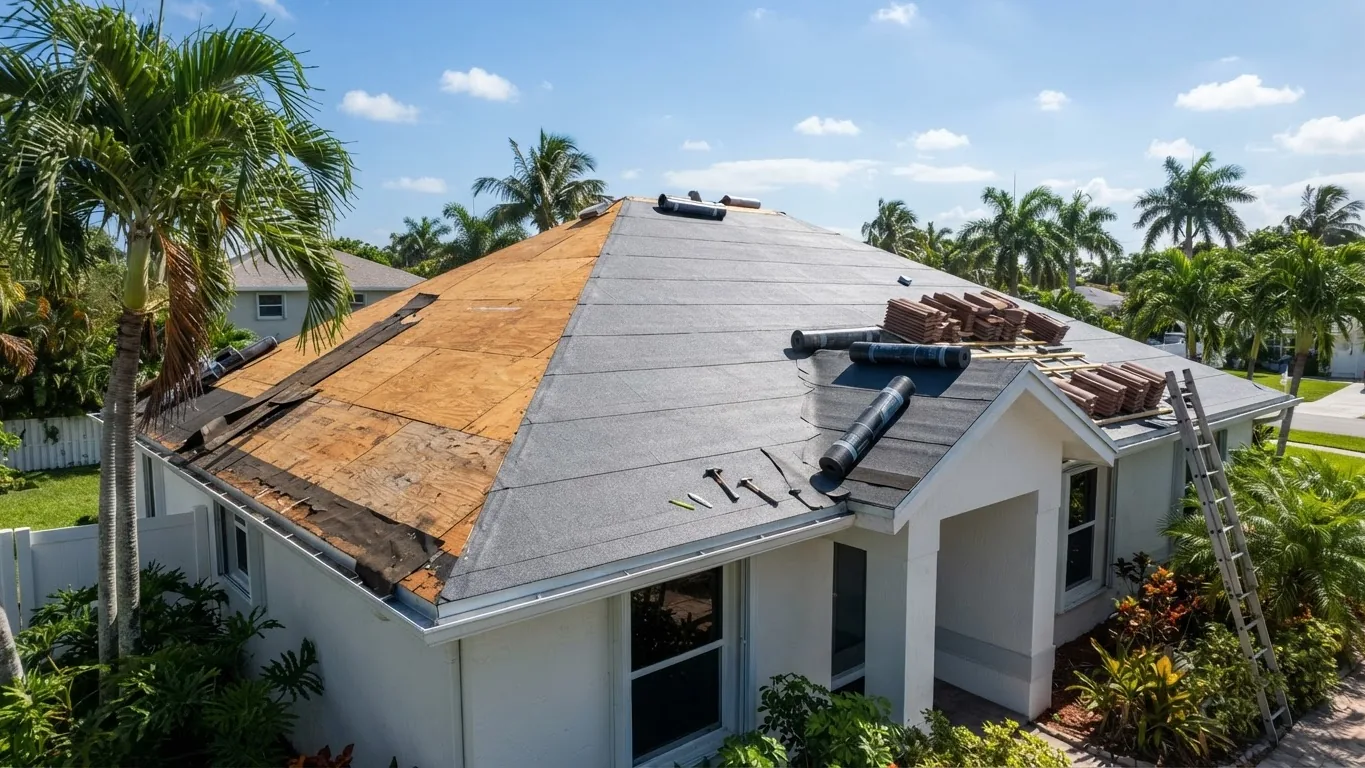
Almost every roof replacement in Broward County needs a permit - and because the whole county sits inside Florida's High-Velocity Hurricane Zone (HVHZ), that permit comes with stricter rules and more inspections than anywhere else in the state. This guide walks through how a Broward roof permit actually works in 2026: who pulls it, the special HVHZ application, the inspections your roof has to pass, and the timeline and fees to expect.
Why Broward requires a permit for (almost) every roof
Broward County sits entirely within the HVHZ, where roofing systems must be engineered to resist sustained winds of roughly 170 mph. Because of that, a building permit is required for a full roof replacement and for most repairs - not paperwork for its own sake, but the mechanism that forces the roof to meet current code and get inspected. Florida's 25% rule adds to this: if more than 25% of a roof section is repaired or replaced within a 12-month period, that whole section generally has to be brought up to current code, which can turn a repair into a permitted replacement.
Who pulls the permit - and why it should be your contractor
In Broward, a licensed roofing contractor should pull the permit in their own name. That matters more than it sounds. When the contractor is the permit holder, they carry responsibility for the work passing inspection and meeting code. Homeowners can sometimes pull an owner-builder permit, but doing so shifts legal responsibility - and liability - onto you, and most homeowners are not equipped for that on an HVHZ roof.
- A licensed contractor pulling the permit keeps responsibility where it belongs
- The permit ties the job to the contractor's license, which you can check at myfloridalicense.com
- An owner-builder permit makes you the responsible party for code compliance and safety
- Work done with no permit at all is the biggest red flag of all - see the last section
The HVHZ Uniform Permit Application - what's different
Broward and Miami-Dade use a special HVHZ Uniform Roofing Permit Application - a different form from the rest of Florida. It requires the specifics that make an HVHZ roof legal, including the product approvals for every material going on the roof. Each tile, shingle, metal panel, underlayment and fastener has to carry a current Notice of Acceptance (NOA) or an HVHZ-rated Florida approval, and those numbers go on the application. If you want to understand that piece, see our guide to what a Miami-Dade NOA is and why it matters.
Step by step - from application to closed permit
The process is predictable once you know the stages:
- Application - your licensed contractor submits the HVHZ Uniform Permit Application with the scope of work, NOA numbers and license information to your city or county building department
- Plan review - the building department checks it for code compliance, typically taking around 10 to 30 days depending on the jurisdiction and backlog
- Permit issued - work can begin; the permit is valid for 180 days, so the job must start within that window
- Inspections - the roof is inspected at several stages as it is built (below)
- Final inspection and close-out - once the final passes, the permit is closed and the job is officially complete
Note that most Broward cities - Fort Lauderdale, Hollywood, Pembroke Pines, Coral Springs, Pompano Beach, Miramar and others - run their own building departments with their own queues, so timelines vary by city.
The inspections: why an HVHZ roof gets three or more
Outside the HVHZ a re-roof might get one or two inspections. In Broward it typically gets three or more, because the parts that protect your home are hidden once the covering goes on. The inspector has to see them first:
- Deck and re-nailing - the sheathing is re-nailed to current code (8d ring-shank nails, roughly 6 inches on center at edges and field) and inspected before anything covers it
- Dry-in / secondary water barrier - the underlayment and secondary water barrier are inspected before the roof covering is installed
- In-progress - tile and metal systems get an additional check while being installed
- Final - the inspector confirms the finished roof matches the permit, the NOAs and the HVHZ details
Each stage has to pass before the next begins. Skipping one is not an option - the work simply cannot be closed.
The secondary water barrier - the requirement that saves your ceiling
One HVHZ requirement is worth understanding as a homeowner: the secondary water barrier (SWB). It is a sealed layer bonded to the roof deck beneath the underlayment, so that if wind tears the covering off during a storm, water still cannot pour straight into your home. It is the difference between a damaged roof and a destroyed interior. Because it is buried under everything else, the dry-in inspection is the only chance to verify it was done right - which is exactly why that inspection exists.
Timeline, fees and the 180-day clock
Costs vary by jurisdiction and project value, but a few things are consistent:
- A nonrefundable permit application processing fee is due at submittal (around $125 at the county level; cities set their own)
- Permit fees are calculated from the project's valuation and scope
- Plan review commonly runs about 10 to 30 days
- The issued permit is valid for 180 days - if work does not begin in time, it expires and must be renewed
Renomatix is not affiliated with, endorsed by, or acting on behalf of any government agency or program. Always confirm current fees and requirements with your local building department.
What an unpermitted roof costs you later
Skipping the permit to save time or money almost always backfires. An unpermitted or improperly closed roof can:
- Fail to close out, leaving an open permit that surfaces during a home sale
- Void or complicate insurance claims and wind-mitigation credits
- Force a tear-off and re-do to satisfy the building department after the fact
- Create liability if the roof fails in a storm
A properly permitted roof, with every inspection signed off, is also the documentation your insurer wants to see for wind-mitigation discounts - so the permit protects your wallet twice.
Frequently asked questions
Do I need a permit to replace my roof in Broward County?
Yes. A full roof replacement requires a permit, and so do most repairs. Under the 25% rule, repairing or replacing more than 25% of a roof section within 12 months generally triggers a full-code replacement of that section.
How long does a Broward roof permit take?
Plan review commonly runs about 10 to 30 days, depending on the city or county and its current backlog. Most Broward cities operate their own building departments, so timelines vary by jurisdiction.
How many inspections does an HVHZ roof need?
Typically three or more - a deck/re-nailing inspection, a dry-in inspection of the underlayment and secondary water barrier, an in-progress check for tile or metal, and a final. Each must pass before the roof can be closed out.
Can I pull the roof permit myself?
Sometimes, as an owner-builder - but it makes you the party responsible for code compliance and safety on an HVHZ roof. For most homeowners it is far safer to have a licensed contractor pull the permit in their name.
Getting started
The permit and inspection process is where HVHZ roofing gets its teeth - and where an inexperienced or unlicensed contractor gets exposed. The simplest way to stay on the right side of it is to work with roofers who pull Broward and Miami-Dade permits every week and treat the inspections as routine. Renomatix is a free service that connects South Florida homeowners across Broward and Miami-Dade with licensed contractors in our network who work the HVHZ - so you can compare written quotes, confirm the permit and product approvals up front, and choose with confidence. One request, several quotes, zero cost to you. Financing is available for qualifying homeowners - no upfront cost* (*third-party financing, subject to credit approval; not all homeowners qualify). Verify any contractor's license at myfloridalicense.com. If your project may straddle year-end, see our guide to Florida's 2026 9th Edition Building Code for what changes on December 31, 2026.