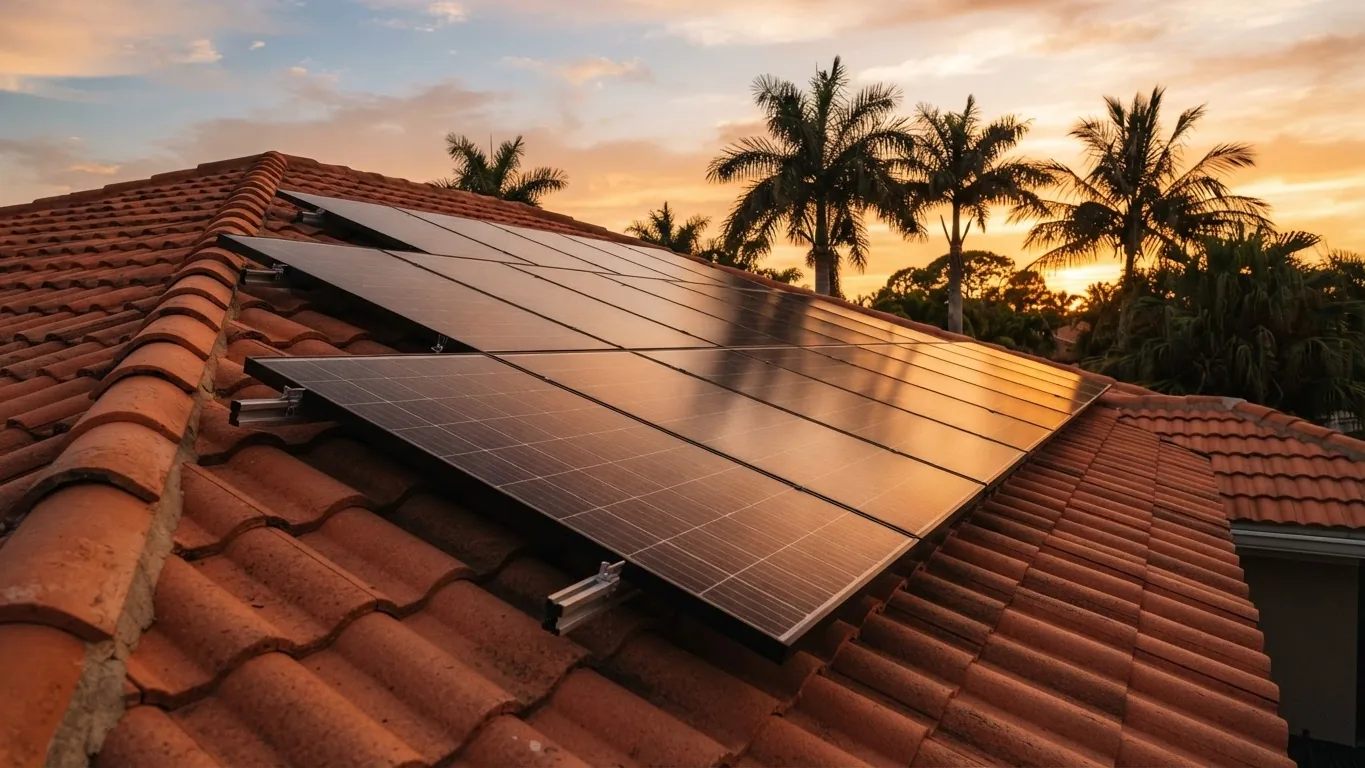
For years, the headline reason to go solar was a 30% federal tax credit. That credit expired on December 31, 2025 - so the honest question for a Broward or Miami-Dade homeowner in 2026 is whether solar still makes sense without it. The short answer: the math changed, but several Florida-specific factors did not. Here is the real picture, minus the sales pitch.
What actually expired - and what didn't
On July 4, 2025, the One Big Beautiful Bill terminated the Section 25D Residential Clean Energy Credit after December 31, 2025. There was no phase-down - it simply ended. If you buy a system with cash or a loan and it is placed in service in 2026, your federal credit is $0.
- The 25D 30% credit is gone for systems bought with cash or a loan in 2026
- If your system was completed and placed in service in 2025, you can still claim it on your 2025 return (filed in 2026)
- Unused 25D credit from a qualifying 2025 project can generally be carried forward
- The commercial 48E credit still exists - but only the equipment owner claims it (see leases below)
- Florida's own solar incentives were left untouched
This is general information, not tax advice - confirm your situation with a tax professional. Renomatix is not affiliated with, endorsed by, or acting on behalf of any government agency or program.
The Florida incentives that survived
The federal credit got the attention, but three Florida-specific benefits are still on the books in 2026, and together they move the arithmetic more than most homeowners expect.
- Sales-tax exemption - solar equipment (panels, inverters, racking) is exempt from Florida sales tax, trimming roughly 6-7% off the hardware cost up front
- Property-tax exemption - adding solar, and qualifying battery storage, does not raise your home's assessed value, so you keep the added value without a higher tax bill
- Net metering - Florida's investor-owned utilities, which serve Broward and Miami-Dade, still credit the excess power you export at the full retail rate, 1-to-1
Municipal utilities and electric co-ops set their own rules, so confirm the policy that applies to your specific address before you count on it.
Leases and PPAs - where 30% still lives
There is one route where the 30% incentive effectively survives: third-party ownership. With a solar lease or a power-purchase agreement (PPA), a company owns the equipment on your roof. Because that company is the owner, it can claim the commercial 48E investment tax credit and, in a competitive market, pass part of that value back to you as a lower monthly payment.
- You do not own the system, so you cannot claim any credit yourself - the owner does
- Your savings show up as a reduced lease or PPA rate, not a tax refund
- Read the escalator clause - many agreements raise the payment a few percent every year
- A lease can complicate a future home sale or a roof replacement, because the contract must be transferred or the panels temporarily removed
Ownership (cash or loan) versus third-party (lease or PPA) is now the central decision, and in 2026 it is driven as much by the tax situation as by the equipment itself.
The HVHZ factor most solar quotes ignore
Broward and Miami-Dade are Florida's only two High-Velocity Hurricane Zone (HVHZ) counties, and that changes a rooftop solar project in ways a national savings calculator never accounts for.
- Every mounting system and attachment must meet HVHZ wind-load requirements - a rack that is fine in Orlando may not be permittable here
- The racking and attachments often need Miami-Dade product approval (an NOA) or equivalent HVHZ approval; a statewide Florida Product Approval alone may not be enough
- Panels add uplift load, so the roof structure and its attachment schedule must be engineered for it
- Permitting and inspection are stricter and take longer than in most of the state
This is exactly why a local evaluation beats an online estimate - the code details drive both the cost and whether the system can be permitted at all.
Don't put panels on a roof that's near the end
The single most expensive solar mistake in South Florida is mounting a new array on an aging roof. If the roof needs replacing in a few years, someone has to remove and reinstall the panels to do it - a real cost that can erase years of savings. And under Florida's 25% rule, once you repair or replace more than 25% of a roof section within 12 months, that whole section must be brought up to current code, which can turn a modest repair into a full replacement. The fix is simple: sequence the work correctly. Sort out the roof first, then add the solar.
So is solar still worth it in 2026?
Without the 30% federal credit, the payback period on a cash or loan purchase is longer than it was in 2025 - there is no way around that. Whether it still pencils out depends on your electric bill, your roof, your financing and how long you plan to stay. Solar tends to make the most sense when:
- Your monthly electric bills are consistently high - more usage means more to offset
- You have a newer roof, or you are replacing it anyway, with good south or west exposure and little shade
- You plan to stay long enough to reach the (now longer) break-even point
- You have compared an ownership purchase against a lease or PPA on total lifetime cost, not just the monthly number
Treat any dollar figure you see online as a typical market range, not a quote. The only number that really matters is a written estimate for your actual home and roof.
Frequently asked questions
Can I still get the 30% federal solar tax credit in 2026?
Not for a system you buy with cash or a loan in 2026 - the Section 25D credit expired December 31, 2025. The only way to benefit from the 30% now is indirectly, through a lease or PPA where the equipment owner claims the commercial 48E credit and passes savings along in your rate. This is general information, not tax advice.
Did Florida's own solar incentives expire too?
No. The federal change did not touch Florida's sales-tax exemption, property-tax exemption, or net metering with investor-owned utilities. All three remain in place in 2026.
Is it worth adding solar to an older roof?
Usually not without addressing the roof first. If the roof will need replacing within a few years, the panels have to come off and go back on, adding cost - and in the HVHZ the 25% rule can force a full-section replacement. Handle the roof, then the solar.
Do I need special equipment for the HVHZ?
Often, yes. The racking and attachments typically need HVHZ or Miami-Dade approval and must meet local wind-load requirements. A licensed contractor who works Broward and Miami-Dade every day will know what is permittable here.
Getting started
The solar decision got more complicated in 2026, and that is exactly when a straight, local answer is worth the most. Renomatix is a free service that connects South Florida homeowners across Broward and Miami-Dade with licensed contractors in our network who work in the HVHZ - so you can compare real, written quotes side by side and decide what is right for your home. One request, several quotes, zero cost to you: you compare, you choose, or you walk away. Financing is available for qualifying homeowners - no upfront cost* (*third-party financing, subject to credit approval; not all homeowners qualify). Request a free, no-obligation quote, and verify any contractor's license at myfloridalicense.com.