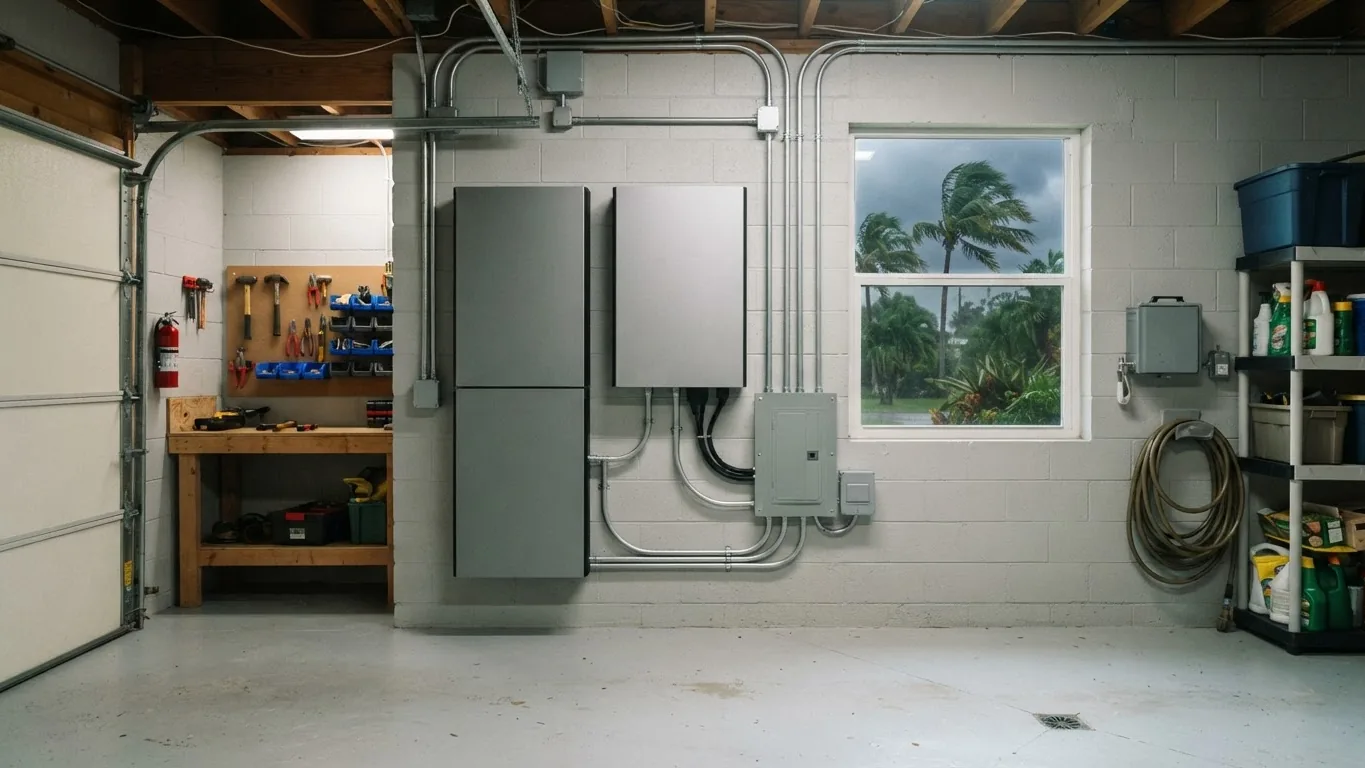
Every South Florida homeowner with solar panels eventually asks the same question after a storm knocks the power out: why is my system not running? The answer surprises most people - a grid-tied solar array shuts down during an outage for safety reasons, unless you have battery storage. A home battery is what turns solar from a monthly savings tool into genuine backup power. Here is how storage works in the Florida climate, what it can realistically run, what drives the cost, and how to decide whether it belongs in your project.
Why grid-tied solar goes dark in an outage
Standard grid-tied systems are required to disconnect when utility power fails. This is called anti-islanding protection, and it exists to keep electricity from flowing back into the lines while crews are working on them. It is a safety feature, not a defect. But it means that during a hurricane outage - exactly when you most want your panels working - a battery-free system produces nothing. Adding storage with a hybrid inverter lets your home safely island itself, so the panels keep charging the battery and the battery keeps your circuits alive.
What a home battery actually powers
A battery is sized in kilowatt-hours of usable capacity, and how long it lasts depends entirely on what you ask it to run. Most South Florida homeowners back up a subset of essential circuits rather than the whole house. Typical priorities:
- Refrigerator and freezer, so food does not spoil during a multi-day outage
- Lights, Wi-Fi, phone and laptop charging
- Medical equipment such as a CPAP machine or oxygen concentrator
- Well pump or sump pump where applicable
- A single AC zone or a mini split - air conditioning is the biggest draw, and backing it up usually requires a larger battery or multiple units
Whole-home backup including central AC is possible, but it changes the size and price of the system substantially. An honest installer will help you decide which circuits truly matter.
How storage performs in the Florida climate
Heat is the enemy of battery life. Lithium batteries degrade faster when they run hot, which is why placement matters more here than in most of the country. A battery mounted in an unconditioned garage that regularly climbs above 95 degrees will not age as gracefully as one in a shaded, ventilated or conditioned space. Salt air along the coast is another consideration - enclosures should be rated for the environment, and outdoor-rated units need appropriate NEMA protection. Ask your installer where the unit will go, how it is cooled, and what the manufacturer's temperature specification actually is.
What drives the cost
There is no single price for solar battery storage, and any quote that arrives without a site assessment should be treated with caution. The main cost drivers:
- Usable capacity - more kilowatt-hours means more equipment and higher cost
- Number of batteries - many homeowners stack two or more units for AC backup
- Whether your existing inverter is battery-ready or must be replaced with a hybrid model
- Electrical work, including a critical-loads subpanel and any panel upgrade
- Permits, inspection and utility interconnection approval, which are required in Miami-Dade, Broward and Palm Beach
Retrofitting a battery onto an existing solar array is often more expensive than including it in the original design, because the inverter and wiring may need to change. If you are installing solar now and think you may want storage later, tell your installer up front and specify battery-ready equipment.
Incentives and financing
Battery storage paired with solar has historically qualified for federal and state incentives, and Florida also exempts qualifying solar and storage equipment from certain taxes and property-tax assessments. Incentive programs change, however, and eligibility rules are specific - confirm current details with a tax professional and with your installer before you count on any figure. Financing is available for qualifying homeowners, and many storage projects are structured so there is no upfront cost. Renomatix is an independent home-improvement company and is not affiliated with any government agency or program.
Battery vs. generator: an honest comparison
A battery is not automatically better than a standby generator - they solve the problem differently. A battery is silent, needs no fuel, requires almost no maintenance, and recharges itself from your panels every sunny day, which makes it well suited to the multi-day outages that follow a Florida storm. A generator, on the other hand, delivers more raw power for less money and will run as long as you can keep fuel in it, but it is noisy, needs servicing, and depends on a fuel supply that gets scarce right when everyone needs it. Some homeowners install both. If your priority is quietly keeping the fridge, lights and internet running for days without touching anything, storage is usually the better fit.
Questions to ask before you sign
Storage is a long-lived investment, so slow down and get the details in writing. Ask an installer:
- What is the usable capacity, not just the nameplate rating?
- Which specific circuits will be backed up, and will the AC run?
- What is the warranty term, and what capacity is guaranteed at the end of it?
- Is the inverter battery-ready, and is it sized for future expansion?
- Are permits, inspection and utility interconnection included in the price?
Getting started
Whether a battery makes sense for your home depends on your energy use, your roof, your existing equipment and how much of the house you want to keep running when the grid goes down. Renomatix connects South Florida homeowners with licensed, insured solar professionals across Miami-Dade, Broward and Palm Beach. Request a free, no-obligation consultation - we will assess your home, explain your storage options in plain language, and provide a clear written estimate with financing available for qualifying homeowners.