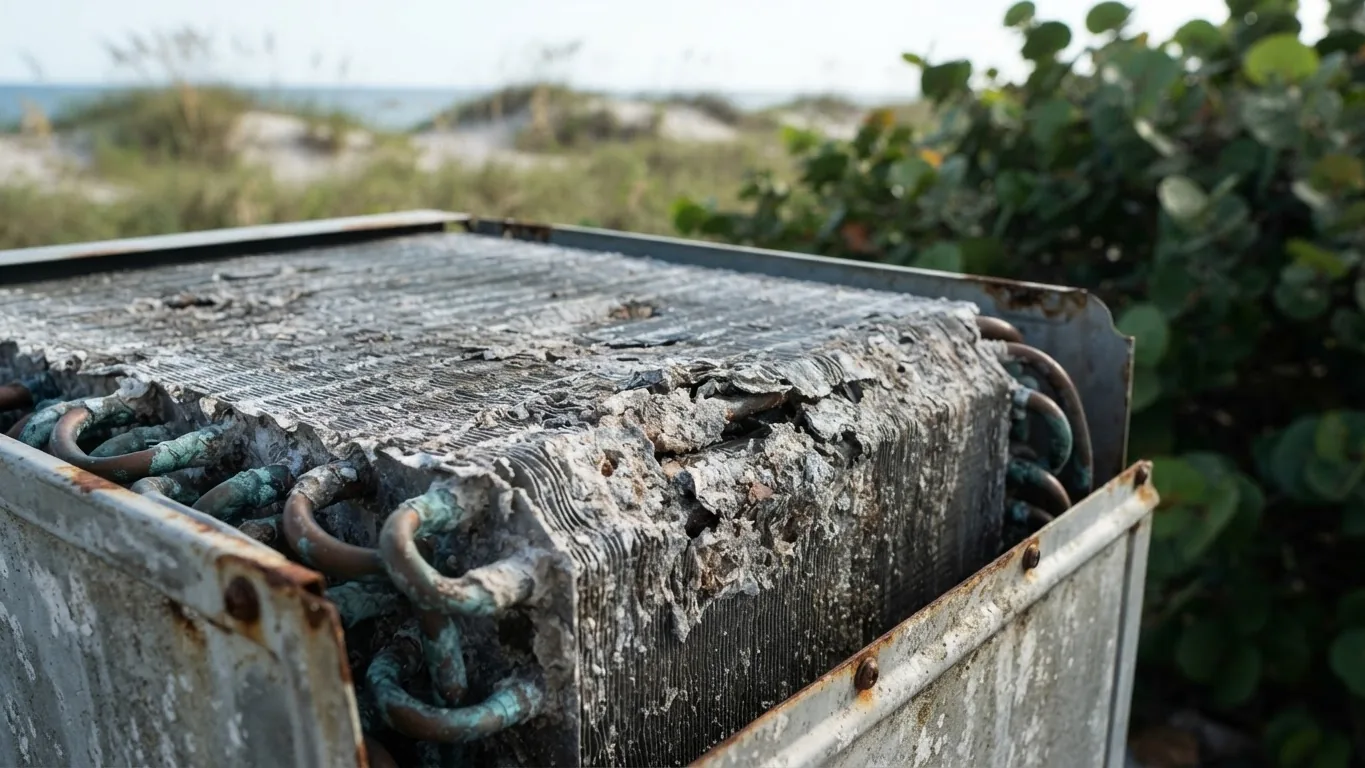
If you own a home near the water in Broward or Miami-Dade, the ocean you love is quietly working against your air conditioner, your roof fasteners and every piece of exposed metal on the property. Salt-laden air is one of the most aggressive corrosion drivers there is, and coastal South Florida delivers it year-round alongside heat and humidity. That combination is why a condenser that would last well over a decade inland can look tired and rust-streaked in half the time a few blocks from the beach. Here is what salt air actually does, why the coast makes it worse, and what you can realistically do about it.
What salt-air corrosion actually does
Salt air is not just humid air. Tiny airborne droplets carry dissolved sodium chloride that settles on every surface and, in the presence of moisture and oxygen, accelerates the electrochemical reaction we call corrosion. On aluminum it shows up as a white, powdery bloom and pitting; on steel and iron it becomes rust; where two different metals touch — copper tubing against an aluminum fin, a steel screw in an aluminum panel — it drives galvanic corrosion, where one metal sacrifices itself and fails faster than either would alone. The damage is cumulative and mostly invisible until a fin crumbles, a fastener snaps, or a coil starts leaking refrigerant.
Why the coast in Broward and Miami-Dade is a worst case
Plenty of places have salt air. Few pair it with this much heat and humidity for this many months of the year. Warm, moist, salty air keeps surfaces damp longer, and every reaction runs faster at higher temperature — so the same salt does more damage here than it would in a cooler coastal climate. Add the prevailing easterly sea breeze that carries salt spray inland off the Atlantic, and the barrier-island and beachfront neighborhoods of Hollywood, Fort Lauderdale, Pompano Beach, Sunny Isles and Miami Beach sit in about the harshest corrosion environment a residential system will ever face. It is the same reason coastal railings, light fixtures and door hardware here rust years before their inland twins.
The AC condenser: usually the first casualty
Your outdoor condensing unit is the piece that suffers first, because it sits outside 24/7 pulling that salt air straight through itself. The most vulnerable part is the coil: a dense grid of thin aluminum fins bonded to copper tubing. Salt corrodes the fins, which reduces the unit’s ability to shed heat, so it runs longer and hotter to do the same job — you feel it as weaker cooling and a higher power bill before you ever see the damage. Left long enough, corrosion reaches the tubing and joints and you get a refrigerant leak, which is often the point where repair stops making sense. Cabinet panels, fasteners and the fan motor housing corrode on a similar clock.
It is not just the AC — salt attacks the whole house
Salt air does not single out the condenser. Anywhere exposed metal meets coastal air, the same process is running:
- Roof fasteners and flashing — corroded nails and clips weaken the roof-to-deck and roof-to-wall connections that matter most in the HVHZ
- Metal roofing and drip edge — coastal exposure is exactly why coated, corrosion-rated metal and stainless fasteners are specified near the water
- Garage door springs, tracks and hardware — salt-seized rollers and rusted springs are a common coastal failure
- Impact-window and door frames, hinges and locks — hardware pits and stiffens, and untreated frames streak
- Railings, gutters, light fixtures and outdoor kitchens — the visible early-warning signs that salt is reaching your equipment too
How good equipment fights back
Manufacturers make corrosion-resistant versions of most exposed products precisely for coastal buyers. When you get a quote near the water, these are the protections worth asking about by name:
- Coated condenser coils — factory-applied coil coatings (and all-aluminum “microchannel” coils) resist salt far better than a bare copper-and-aluminum coil
- Coastal or “seacoast” equipment packages — treated fasteners, protected cabinets and hardware rated for a stated distance from salt water
- Stainless or coated fasteners — on roofing, railings and any outdoor assembly, the fastener is often the first thing to fail
- Corrosion-rated finishes — on metal roofing, gutters and door hardware specified for a marine environment
- Warranty terms tied to coastal rating — many warranties are reduced or voided if a non-coastal unit is installed too close to the shoreline, so match the equipment to your location
What you can do to extend equipment life
You cannot change where your house sits, but a few habits meaningfully slow the clock:
- Rinse the outdoor condenser coil with plain water on a regular schedule — low pressure only, system off — to wash salt off before it bites
- Keep up routine HVAC maintenance so a technician catches fin and coil corrosion early, while it is still a cleaning-and-coating job
- When you replace equipment near the water, choose the coastal-rated version and a coated coil rather than the base model
- Ask for stainless or corrosion-rated fasteners on any coastal roofing, railing or exterior work
- Hose down railings, tracks and hardware periodically — the same rinse that protects the AC protects everything metal
Repair or replace once corrosion sets in
When a coastal system starts showing its age, the deciding factor is usually where the corrosion is. Surface bloom on the fins can often be cleaned and the coil coated, buying years. But once corrosion has reached the tubing or caused a refrigerant leak, or once the compressor is straining because a fouled coil has made it work too hard for too long, repair costs start chasing the price of replacement — and a patched old unit in a salt-air location tends to fail again soon. If your condenser is already past ten years, visibly corroded and needing refrigerant, it is usually worth pricing a coastal-rated replacement alongside the repair before you spend.
Frequently asked questions
Do I need to live on the beach for salt air to damage my AC?
No. The salt-laden air that drives corrosion carries well inland — industry references commonly treat homes within a few miles of the shoreline as a coastal, or “seacoast,” environment, and the effect is strongest within roughly the first mile. In practice, homes in Hollywood, Hallandale Beach, Fort Lauderdale beach, Pompano Beach and the barrier-island neighborhoods of Miami-Dade see it most, but it reaches inland on the prevailing easterly breeze. If your outdoor coil looks chalky, pitted or white-crusted, salt is already at work.
How much sooner does a coastal AC unit fail?
There is no single guaranteed number, and honest answers come as ranges. A standard condenser that might last 12 to 15 years inland can lose several years of service life in a harsh salt-air location if it is never rinsed or protected, because corrosion attacks the aluminum fins and copper joints that the system depends on. A coastal-rated unit with a coated coil, rinsed regularly, closes much of that gap. These are typical market ranges, not a guarantee for your specific home.
Does rinsing the condenser actually help?
Yes, and it is the single cheapest thing you can do. Salt is water-soluble, so gently rinsing the outdoor coil with plain water on a regular schedule washes deposits off before they eat into the metal. Use low pressure — a pressure washer bends the fins and does more harm than good — and turn the system off first. It will not reverse damage that has already happened, but it dramatically slows new corrosion.
Are coastal or seacoast-rated units worth the extra cost near the water?
For a home close to the shoreline, usually yes. Coastal or “seacoast” packages add corrosion-resistant coil coatings, treated fasteners and cabinet protection designed for salt exposure, and many manufacturers tie their full warranty to using the coastal version within a set distance of salt water. Ask any contractor quoting you whether the equipment is rated for your distance from the coast, and get the warranty terms in writing.
Getting started
Start with a look at your outdoor unit. Chalky white fins, rust streaks on the cabinet or a coil that looks furry with corrosion are all signs salt is winning. If the system is under about eight years old and the corrosion is still on the surface, a maintenance visit and coil cleaning may be all you need. If it is older, visibly eaten and struggling to cool, it is worth pricing a coastal-rated replacement before you sink money into another repair.
One free request puts you in front of licensed contractors in our network who work coastal Broward and Miami-Dade and understand what salt air does to equipment here. You get free, no-obligation quotes, you compare them side by side, and you decide — or you walk away. Ask each one whether the equipment is rated for your distance from the coast, and verify any Florida license at myfloridalicense.com before you sign anything.