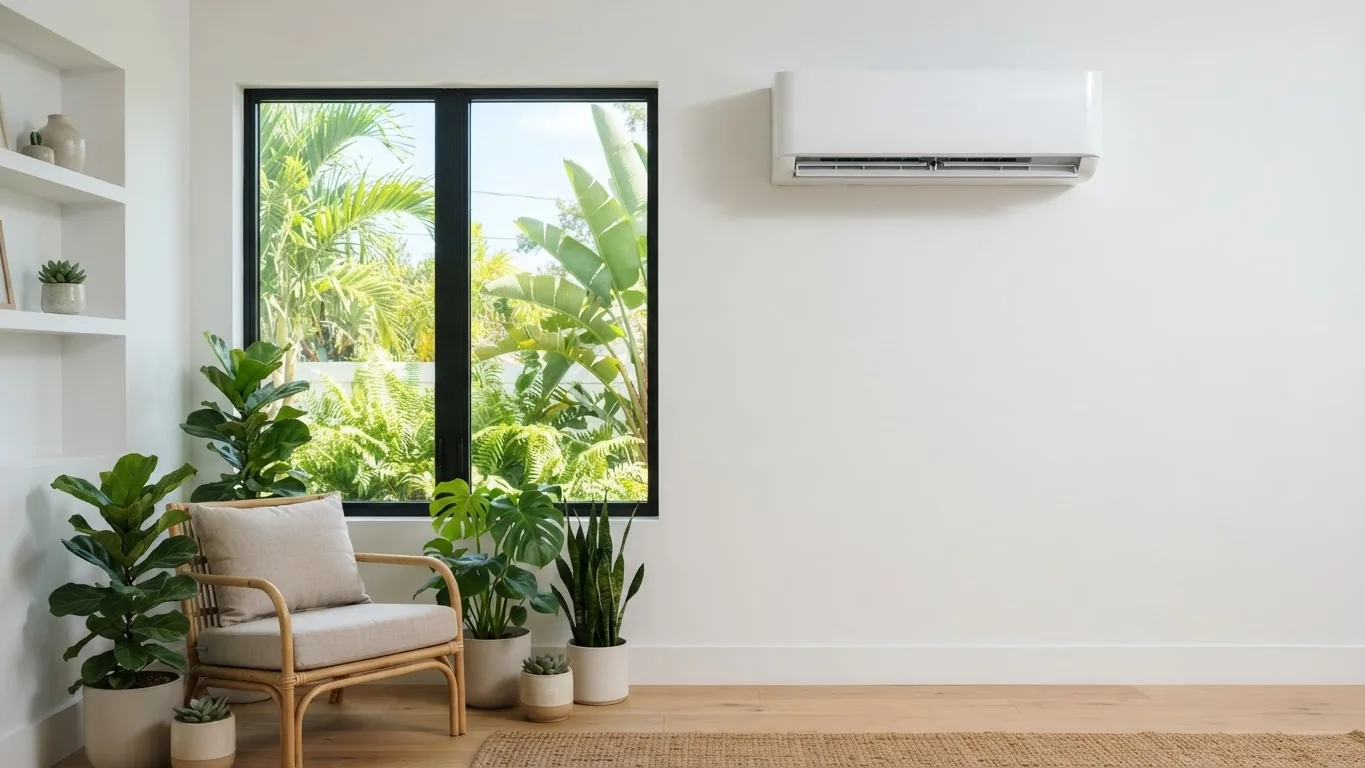
Ductless mini split systems have become one of the most popular ways South Florida homeowners cool spaces that a central AC system struggles to reach - a converted garage, a new addition, a Florida room, or a bedroom that never quite gets cold enough. They install without ductwork, run quietly, and let you set different temperatures in different rooms. But a mini split is not the right answer for every home. This guide explains how ductless systems work in the Miami-Dade, Broward and Palm Beach climate, and when they genuinely make sense.
How a ductless mini split actually works
A mini split has two main parts: an outdoor compressor unit and one or more indoor air handlers mounted on a wall or ceiling. They connect through a small conduit that carries refrigerant and power, so no bulky ducts are needed. Each indoor head cools the zone it serves and is controlled independently, which is why the systems are often called 'zoned' or 'ductless.' A single outdoor unit can support one indoor head or several, depending on the model.
Why they suit the South Florida climate
Our climate is defined by long cooling seasons, high humidity and relentless heat, and modern mini splits are built to handle exactly that. Key advantages for a Florida home:
- Strong humidity control - variable-speed compressors run longer at lower output, pulling more moisture from the air than a system that cycles on and off
- High efficiency - many ductless systems carry very high SEER2 ratings, which matters when the AC runs most of the year
- Room-by-room zoning - cool only the spaces you use instead of the whole house
- Quiet operation - indoor heads are far quieter than a window unit
- No duct losses - ductwork in a hot Florida attic can waste a meaningful share of your cooling
Where a mini split makes the most sense
Ductless systems shine in specific situations rather than as a blanket replacement for every central system. Consider one when you have:
- A room addition, garage conversion or enclosed patio with no existing ductwork
- A bedroom or home office that stays hotter than the rest of the house
- An older home with no ducts, where adding them would be invasive and costly
- A space you want to cool separately without running the whole-home system
- A guest suite, in-law apartment or ADU that benefits from its own thermostat
When central AC is still the better choice
Mini splits are not always the answer. If your home already has sound ductwork and you are replacing a failed system, a central air conditioner is often more cost-effective and keeps a cleaner look with no wall-mounted heads. Large open floor plans can also be cooled efficiently by a single central system. In many South Florida homes the best solution is a hybrid: keep central air for the main living areas and add a mini split for the one or two problem spaces it never reached.
What drives the cost
Mini split pricing in South Florida depends far more on the design of your project than on any single sticker price. The biggest factors:
- Number of indoor zones - each additional head adds equipment and labor
- System capacity and efficiency - higher-SEER2 and multi-zone units cost more
- Installation complexity - line-set length, wall type and electrical work
- Whether new electrical circuits or a panel upgrade are needed
- Permits and inspection, which are required for HVAC work in Miami-Dade and Broward
Because every install is different, treat online figures as a rough starting point and ask for an itemized written estimate for your specific home.
Permits, sizing and hurricane considerations
HVAC installations in South Florida require a permit and inspection, and a licensed contractor should pull it - never skip this step, because unpermitted work can create problems at resale and void manufacturer warranties. Proper sizing matters just as much: an oversized unit short-cycles and leaves the air clammy, while an undersized one runs constantly and never keeps up. A good installer performs a load calculation rather than guessing. Outdoor condensers should also be mounted and secured to withstand high winds, and coastal homes benefit from corrosion-resistant coatings to stand up to salt air.
Maintenance and lifespan
Ductless systems are low-maintenance but not no-maintenance. Indoor filters should be cleaned regularly - easy to do yourself - and the coils and drain lines benefit from an annual professional service, especially given Florida's humidity and the risk of clogged condensate lines and mold. Well-maintained mini splits can deliver many years of reliable service, and keeping up with simple upkeep protects both efficiency and any warranty coverage.
Getting started
Whether a ductless mini split, a new central system or a hybrid setup is right for your home comes down to your layout, your existing ductwork and the specific spaces you need to cool. Renomatix connects South Florida homeowners with licensed, insured HVAC professionals who work across Miami-Dade, Broward and Palm Beach. Request a free, no-obligation consultation - we will assess your home, walk you through the options and provide a clear written estimate, with financing available for qualifying homeowners. Renomatix is an independent home-improvement company and is not affiliated with any government program.